Vincent van Gogh’s life was a pilgrimage of passion, pain, and profound creativity—a journey that took him from the muted, brooding landscapes of the Netherlands to the incandescent light of Provence. To follow in his footsteps is to trace not just a physical route across Europe, but to map the very evolution of a genius whose work forever altered the course of art. This is a voyage into the heart of what it means to see, to feel, and to translate the raw intensity of life onto canvas.
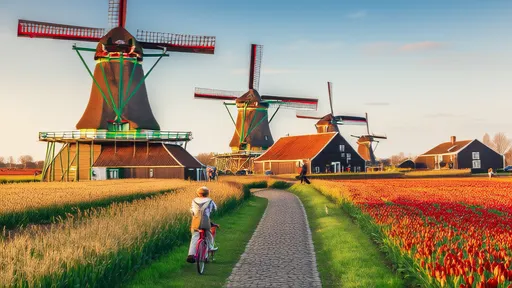
The story begins in the Netherlands, in the small Brabant village of Zundert, where Vincent was born in 1853. The Van Gogh Museum in Amsterdam houses the world’s largest collection of his work, but to understand the roots of his emotional depth, one must venture south to the Noordbrabants Museum in ’s-Hertogenbosch. Here, early works like The Potato Eaters reveal an artist consumed by the harsh, earthy reality of peasant life. The palette is dark, almost somber, heavy with browns, grays, and olive greens. You can feel the weight of the Netherlands in these paintings—the low skies, the tough existence, the solemn dignity of labor. It was here that Vincent first grappled with his mission: to portray humanity in its most unvarnished form.
From there, the trail leads to Nuenen, another Dutch town where Van Gogh lived for two years. The Vincentre Museum offers a poignant glimpse into this period, a time of personal tragedy and artistic struggle. It was in Nuenen that he painted the haunting The Vicarage at Nuenen and numerous studies of weavers and farmers. The landscapes here are flat, subdued, and often veiled in twilight or rain. Walking the paths he once walked, past the water mills and cottages he sketched, you sense the loneliness that began to seep into his soul—a loneliness that would both torment and drive him.
But the Netherlands could not contain him forever. In 1886, Van Gogh moved to Paris to live with his brother Theo, an art dealer. This was a seismic shift. Immersed in the vibrant avant-garde scene, he encountered the works of the Impressionists and Japanese ukiyo-e prints, which exploded his understanding of color and composition. The somber Dutch palette gave way to experiments with brighter hues and looser brushwork. Though much of Paris has changed, places like Montmartre still echo with the ghosts of that bohemian world. The Basilica of the Sacré-Cœur, which he painted, still looks down upon the city, and one can imagine Vincent trudging through these streets, his mind ablaze with new ideas, yet increasingly agitated by the city’s frenetic pace.
It was the overwhelming intensity of Paris, however, that eventually pushed him south. In search of peace, clearer light, and a cheaper cost of living, he boarded a train to Arles in February 1888. This journey marked the beginning of his most prolific and iconic period. The moment he arrived, he wrote to Theo of the "limpid quality of the air" and the "beautiful effects of yellow and green." Arles was a revelation. The Provençal light—sharp, crystalline, drenching everything in a radiant glow—transformed his art completely.
In Arles, the world knows the famous Yellow House, which he rented and painted with joyous expectation. Though the original building was destroyed during World War II, a plaque marks its site on the Place Lamartine. Here, he dreamed of establishing a "Studio of the South," a communal haven for artists. It was here that Paul Gauguin joined him for a brief, fateful nine weeks—a period that culminated in the infamous ear-cutting incident and Van Gogh’s first serious mental collapse. Yet, from this turmoil emerged some of his greatest masterpieces: The Night Café, with its feverish, oppressive atmosphere; Starry Night Over the Rhône, a symphony of blue and gold; and the radiant Sunflowers series, intended to decorate Gauguin’s room.
Today, Arles embraces its Van Gogh legacy. The Fondation Vincent van Gogh Arles hosts contemporary exhibitions responding to his work, while the Espace Van Gogh—formerly the hospital where he was treated—now blooms in the courtyard he once painted, exactly as he depicted it. Walking through the town, you can visit the Trinquetaille bridge, the Alyscamps necropolis, and the Langlois Bridge, all immortalized in his work. The light remains exactly as he described it—a dazzling, almost supernatural force that clarifies form and heightens color to an emotional pitch.
After the breakdown in Arles, Van Gogh voluntarily admitted himself to the Saint-Paul-de-Mausole asylum in Saint-Rémy-de-Provence, just a short drive away. Confined yet incredibly productive, he entered another staggering burst of creativity. The world knows the swirling, visionary The Starry Night, painted from his window here. But he also produced over 150 works during his year in Saint-Rémy, including irises, olive groves, and cypress trees—all rendered with that distinctive, turbulent energy. The asylum remains open to visitors; its cloisters, gardens, and the surrounding countryside look much as they did in his time. There is a profound stillness here, a melancholy beauty that seems to resonate with his struggle for sanity and solace through art.
His final stop was Auvers-sur-Oise, a small village north of Paris, where he moved in May 1890 to be closer to Theo and under the care of Dr. Paul Gachet. In just 70 days, he produced nearly 80 paintings. The landscapes here—wide, rolling fields under vast skies—were captured with a new urgency. Works like Wheatfield with Crows, with its ominous, dark birds soaring over a golden sea of grain, are often interpreted as harbingers of his impending death. The Auvers town hall, the church, and the thatched cottages all appear in his paintings, unchanged to this day. He rented a small room at the Auberge Ravoux, where he died on July 29, 1890, from a gunshot wound, widely believed to be self-inflicted. He was buried in the local cemetery, next to his beloved brother Theo, who died just six months later.
The journey from the Netherlands to the South of France is more than a tourist trail; it is a passage through the inner landscape of a tormented visionary. In the gray, earnest north, he learned empathy and observation. In Paris, he absorbed innovation and chaos. But it was under the sun of Provence that his art caught fire. The light of the south did not just illuminate his subjects; it illuminated his soul, pushing his technique to its breaking point and yielding some of the most emotionally charged paintings the world has ever seen.
To walk this path is to understand that Van Gogh was not just painting places; he was painting feeling. Every brushstroke was a heartbeat, every color a surge of emotion. From the dark soil of Brabant to the golden fields of Auvers, his journey was a relentless search for truth, beauty, and a sense of belonging in a world that often felt alien. His art was his anchor, his solace, and ultimately, his immortal legacy.

By /Sep 1, 2025
By /Sep 1, 2025
By /Sep 1, 2025
By /Sep 1, 2025
By /Sep 1, 2025

By /Sep 1, 2025

By /Sep 1, 2025
By /Sep 1, 2025
By /Sep 1, 2025
By /Sep 1, 2025
By /Sep 1, 2025

By /Sep 1, 2025
By /Sep 1, 2025
By /Sep 1, 2025
By /Sep 1, 2025
By /Sep 1, 2025
By /Sep 1, 2025
By /Sep 1, 2025
By /Sep 1, 2025
By /Sep 1, 2025