There is a road in Germany that seems spun from starlight and stories, a ribbon of pavement that winds through some of the most achingly beautiful landscapes in Europe. This is the Romantic Road, or Romantische Straße, a journey that promises not just a change of scenery, but a shift in the very soul. It is a pilgrimage into the heart of a fairy tale, a path that leads travelers through medieval towns untouched by time, past rolling vineyards and emerald forests, and ultimately, to the crescendo of this dream: the castles of King Ludwig II, most notably the ethereal Neuschwanstein. To travel this road is to willingly step into a storybook, one where every bend reveals a new chapter of enchantment.
The Romantic Road itself is a post-war creation, a clever and beautiful marketing idea designed to lure travelers to southern Germany. But the magic it sells is utterly authentic. Stretching approximately 400 kilometers from Würzburg in the north to Füssen in the foothills of the Alps, the route connects a series of towns and landscapes that have preserved their historical character with remarkable care. It is not merely a highway but a carefully curated experience, a timeline of German history and culture presented as a living museum. The journey invites you to slow down, to meander, and to absorb the atmosphere of a region that has fiercely held onto its romantic ideals.
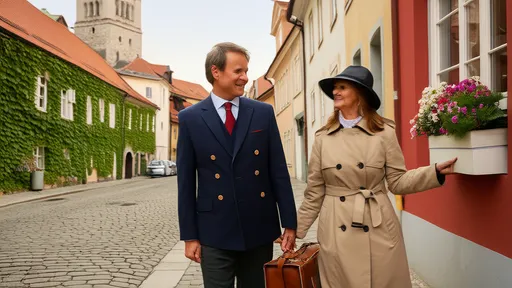
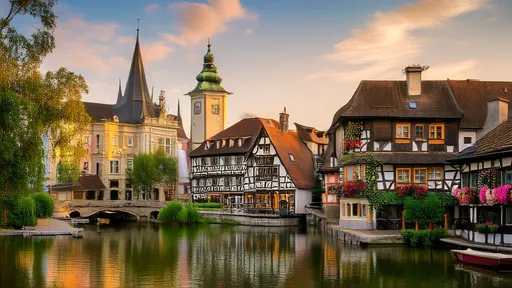
Beginning in the north, the baroque splendor of Würzburg, with its magnificent Residenz Palace, sets a grand stage. But the true charm of the road reveals itself in the smaller, perfectly preserved medieval towns that dot the route. Towns like Rothenburg ob der Tauber are not so much visited as they are experienced. Encircled by intact defensive walls, its cobblestone lanes wind past half-timbered houses with steeply pitched roofs, their window boxes overflowing with red geraniums. Walking through these streets, especially in the quiet of the early morning or the golden glow of evening, feels like walking through a dream. The air smells of baking bread and woodsmoke, and it is easy to imagine the clatter of a knight's horse or the whisper of a merchant from centuries past. This is not a reconstruction; it is a place where history breathes.
Further south, the town of Dinkelsbühl offers a similar, if quieter, charm, its central market square a masterpiece of Gothic and Renaissance architecture. Meanwhile, Nördlingen presents a unique wonder: it is a medieval town built entirely within a massive meteorite crater. Life here has continued within this celestial footprint for over a thousand years, a fact that adds a layer of cosmic wonder to the already potent historical atmosphere. Each town along the route possesses its own unique character, yet they are united by a common thread: an unwavering commitment to preserving a beauty that feels both genuine and timeless.
As the road winds south, the landscape begins to change, preparing the traveler for the final act of this romantic play. The gentle hills become more pronounced, and the silhouette of the mighty Alps begins to dominate the horizon. The air grows crisper, and the sense of anticipation builds. You are approaching the realm of a king who was less a statesman and more an artist, a visionary who dedicated his life and treasury to building monuments to beauty and fantasy. You are entering the world of King Ludwig II of Bavaria, the Märchenkönig—the Fairy Tale King.
Ludwig II was a profoundly misunderstood and complex figure. Ascending to the throne at just eighteen, he was ill-suited for the political machinations of his time. He was a recluse, a dreamer, and a passionate devotee of art, music, and architecture. He found solace not in court, but in the operas of Richard Wagner and the epic Germanic myths that inspired them. His vision was to create physical manifestations of these mythical worlds, castles that would serve as retreats from a reality he found increasingly unbearable. He didn't build fortresses for defense; he built palaces for dreams.
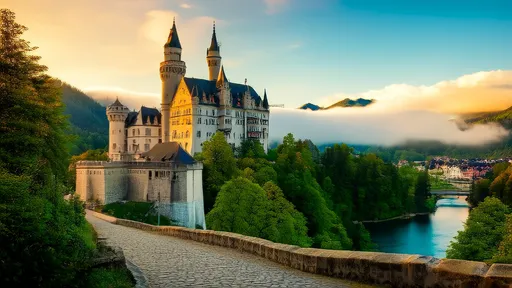
And so, the Romantic Road culminates at the foot of his greatest dream: Neuschwanstein Castle. Perched precariously on a rugged hilltop against a backdrop of snow-capped peaks and serene alpine lakes, Neuschwanstein is the image that has defined the fairy-tale castle for the world. Its white limestone towers and blue turrets seem to pierce the sky, a sight so impossibly perfect that it feels more like a mirage than masonry. Ludwig intended it as a homage to the swan knight Lohengrin from Wagner's opera, and the swan motif is everywhere—in the carvings, the tapestries, the door handles. It is a building utterly consumed by its own theme.
Walking through its rooms is to step directly into Ludwig's imagination. The Throne Room, inspired by Byzantine churches, shimmers with gold and lapis lazuli, though a throne was never installed. The Singer's Hall, a vast space dedicated to the legends of Parzival and Tannhäuser, speaks of his obsession with medieval romance. His own bedroom is a masterpiece of Neo-Gothic woodcarving, so intricate that it took fourteen carvers four years to complete. Yet, for all its grandeur, there is a profound melancholy to Neuschwanstein. Ludwig lived in its incomplete rooms for only 172 days before his mysterious death. It was opened to the public just weeks after he died, transforming his private sanctuary into the very thing he sought to escape: a public spectacle.
But Neuschwanstein is not the only chapter in Ludwig's story. Nearby Hohenschwangau Castle, where he spent much of his youth, offers a glimpse into the influences that shaped him. Its yellow walls are covered in vivid murals depicting German legends, planting the seeds of fantasy that would later fully bloom in his own creations. A little further away, nestled on an alpine lake, is Linderhof Palace. This is the only castle Ludwig lived to see completed, and it is a dazzling, intimate gem. Inspired by Versailles but on a much smaller, more personal scale, its interiors are a riot of Rococo extravagance. The grounds feature a magical grotto—an artificial cave with a lake and a shell-shaped boat, built for private performances of Wagner's operas. It is perhaps the purest expression of Ludwig's theatrical and solitary nature.
The journey along the Romantic Road, ending with the contemplation of Ludwig's castles, is more than a vacation; it is an exploration of a idea. It is about the human desire for beauty, for story, and for escape. The medieval towns show us a historical ideal, a picture of community and craftsmanship from a bygone era. Ludwig's castles show us the power of an individual's dream, however impractical or costly. Together, they form a narrative about Germany's romantic soul—a deep, abiding love for myth, nature, and the artistic spirit.
To stand on the Marienbrücke bridge, looking across a chasm at the perfect profile of Neuschwanstein, is to understand why this place captivates millions. It is not just a castle; it is a symbol. It represents the idea that a dream, no matter how extravagant, can be made real. The Romantic Road is the pathway to that symbol. It is a reminder that in a world often dominated by the practical and the mundane, there is still a place for the poetic, the beautiful, and the utterly fantastical. It is proof that sometimes, if only for a little while, fairy tales can indeed come true.

By /Sep 1, 2025
By /Sep 1, 2025
By /Sep 1, 2025
By /Sep 1, 2025
By /Sep 1, 2025

By /Sep 1, 2025

By /Sep 1, 2025
By /Sep 1, 2025
By /Sep 1, 2025
By /Sep 1, 2025
By /Sep 1, 2025

By /Sep 1, 2025
By /Sep 1, 2025
By /Sep 1, 2025
By /Sep 1, 2025
By /Sep 1, 2025
By /Sep 1, 2025
By /Sep 1, 2025
By /Sep 1, 2025
By /Sep 1, 2025