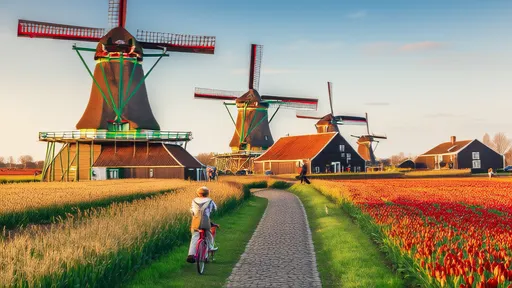
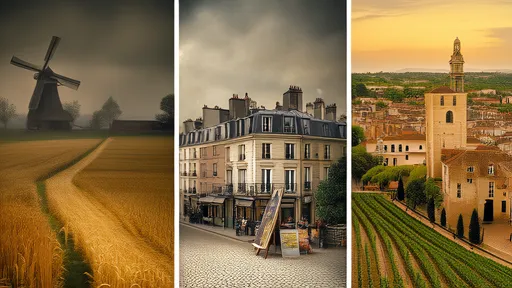
Stepping into the Dutch windmill village feels like entering a living postcard, where history breathes through every wooden blade and brick pathway. The iconic structures stand as stoic guardians of a landscape wrested from the sea, embodying the resilience and ingenuity that define the Netherlands. More than mere tourist attractions, these windmills are monuments to human adaptation, telling a story of how a nation carved its destiny from water and wind.
As the morning mist lifts over the Zaanse Schans, the scent of freshly cut timber and damp earth fills the air. The windmills, with their massive sails turning in a steady rhythm, seem to converse with the elements—a dialogue honed over centuries. Each creak of the wood, each turn of the gear, echoes the relentless battle against nature that shaped the Dutch identity. Here, in this open-air museum, one begins to understand that these machines were not just tools but lifelines, enabling survival in a land where water was both a threat and a resource.
The very existence of the Netherlands is a testament to human tenacity. Much of the country lies below sea level, a geographical reality that forced its inhabitants to become masters of hydraulic engineering. From the earliest inhabitants who built terpen—artificial mounds to escape flooding—to the sophisticated polder systems and dikes of today, the Dutch have continuously refined their relationship with water. The windmills played a pivotal role in this saga, draining lakes and marshes to create arable land, thus expanding the nation’s territory inch by hard-won inch.
Walking through the village, one can observe the intricate mechanics of these marvels. The windmills are not uniform; each was designed for a specific purpose, from sawing wood to grinding grain or pressing oil. The De Kat mill, for instance, still produces pigments using traditional methods, its stones grinding minerals into vivid powders. Meanwhile, De Zoeker and De Bonte Hen continue to extract oil from seeds, a process that hasn’t changed fundamentally in hundreds of years. This specialization highlights a society that valued efficiency and innovation long before the Industrial Revolution.
Beyond their practical functions, windmills became symbols of a collective spirit. Building and maintaining them required cooperation among communities, fostering a culture of collaboration that remains ingrained in Dutch society today. This ethos is mirrored in the country’s water boards, or waterschappen, among the oldest democratic institutions in the world, where stakeholders jointly make decisions about water management. The windmills, therefore, are not just feats of engineering but pillars of a social contract built on shared responsibility.
The architectural harmony of the windmill village also reflects a deep respect for the environment. The structures are built from local materials—wood, brick, and thatch—blending seamlessly into the landscape. Even the placement of the windmills was meticulously planned to harness the prevailing winds optimally. This sustainable approach, born of necessity, resonates strongly in today’s era of climate change, offering lessons in living lightly on the land.
Yet, the wisdom of the Low Countries extends beyond water management. The windmills embody a broader philosophy of turning constraints into opportunities. With limited natural resources, the Dutch learned to leverage what they had in abundance: wind and water. This mindset fueled their Golden Age, when a small nation became a global maritime and economic power. It is a reminder that innovation often springs not from abundance but from scarcity.
Today, as the Netherlands faces new challenges like rising sea levels and urbanization, the legacy of the windmills endures. Modern wind turbines dot the countryside, descendants of their wooden ancestors, generating clean energy for millions. The same pragmatic creativity that built the polders now drives breakthroughs in circular economy and sustainable design. The windmill village, thus, is not a relic but a living laboratory where past and future converge.
Visitors leaving the village often carry with them more than just photographs. They take away a sense of awe at how a nation transformed vulnerability into strength. The windmills stand as quiet mentors, teaching that with ingenuity, cooperation, and respect for nature, even the most daunting obstacles can be overcome. In the gentle turn of their sails, one hears the whisper of centuries: a promise that human wisdom, like the wind, is a force that can shape the world.

By /Sep 1, 2025
By /Sep 1, 2025
By /Sep 1, 2025
By /Sep 1, 2025
By /Sep 1, 2025

By /Sep 1, 2025

By /Sep 1, 2025
By /Sep 1, 2025
By /Sep 1, 2025
By /Sep 1, 2025
By /Sep 1, 2025

By /Sep 1, 2025

By /Sep 1, 2025

By /Sep 1, 2025

By /Sep 1, 2025
By /Sep 1, 2025
By /Sep 1, 2025
By /Sep 1, 2025
By /Sep 1, 2025
By /Sep 1, 2025