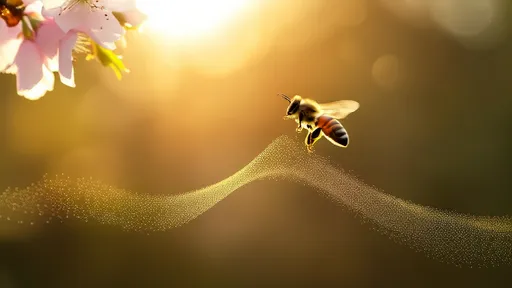
On breezy spring days, while most people admire cherry blossoms or complain about allergies, few notice the invisible matchmaking happening right under their noses. Pollen grains - those golden dust particles that make us sneeze - are actually engaged in an intricate electrostatic dance, using forces we usually associate with rubbing balloons on hair rather than nature's reproductive cycle.
The Electric Romance of Spring
Researchers have discovered that nearly 90% of flowering plant species produce pollen grains that carry natural positive electrostatic charges. Meanwhile, the stigmas (pollen-receiving parts) of their flowers tend to be negatively charged. This creates what physicists call an "electrostatic potential gradient" - essentially nature's version of romantic tension between pollen and flower.
Dr. Clara Voss, a biophysicist at Cambridge who pioneered pollen electrostatics research, describes it as "a silent electrical dialogue that's been going on for millions of years." Her team's high-speed cameras have captured pollen grains making sharp 90-degree turns mid-air to align with a flower's electric field, like iron filings orienting to a magnet.
How Pollen Gets Its Charge
The charging process begins in the anther, where developing pollen grains undergo biochemical changes that leave their outer walls electron-deficient. As the grains mature and dehydrate, this electron imbalance becomes fixed. When released, each grain carries about 30 femtocoulombs of positive charge - that's 0.00000000000003 coulombs, but enough to influence its fate.
Wind-pollinated plants like oaks and grasses produce especially highly charged pollen. Their grains often show surface potentials around +5 volts - comparable to the static that makes your hair stand up after taking off a wool sweater. This makes sense evolutionarily: since these plants can't rely on bees for targeted delivery, they've amplified their electrostatic attraction to compensate.
The Airborne Courtship
Once airborne, charged pollen behaves differently than neutral particles. The electric fields around flowers extend several centimeters out - creating an invisible "landing zone" that guides pollen in. Measurements show pollen deposition rates increase 2-5 fold when electrostatic forces are present versus when they're neutralized.
Interestingly, this system has built-in quality control. Older pollen grains gradually lose their charge, while fresh ones remain strongly positive. Flowers thus preferentially capture the most viable pollen through what amounts to an electrical freshness test.
Certain flowers like poppies and tulips even dynamically adjust their stigma charges throughout the day, creating optimal attraction windows that coincide with peak pollinator activity or ideal humidity conditions. It's a remarkable synchronization of electrical, biological, and environmental factors.
Electrostatic Consequences
This hidden electrical dimension explains several pollination mysteries. For instance, why some plants successfully pollinate even when their male and female flowers are separated by several meters. Or how certain alpine flowers manage fertilization in near-zero wind conditions where conventional aerodynamics would suggest pollination is impossible.
The phenomenon also impacts allergy sufferers. Charged pollen grains adhere more stubbornly to nasal passages and lung tissues. Pharmaceutical researchers are now exploring whether neutralizing these charges could lead to more effective allergy medications.
Climate change may be disrupting these delicate electrical relationships. Rising CO2 levels cause some plants to produce pollen with altered surface chemistries and charge characteristics. Preliminary data suggests this could lead to "electrostatic mismatches" between flowers and their traditional pollen donors.
Technological Inspirations
Engineers are taking notes from this natural system. Several groups are developing electrostatic-assisted drones for precision pollination of crops - particularly valuable as bee populations decline. Early prototypes can achieve 60% pollen adhesion efficiency, compared to 15% for non-assisted drones.
Material scientists are also mimicking pollen's nanostructured surface features to create better electrostatic air filters. One prototype inspired by sunflower pollen can capture 99% of PM2.5 particles while using 30% less energy than conventional HEPA filters.
Perhaps most poetically, some researchers suggest we might reinterpret historical accounts of flowers "reaching out" to passing bees as early human observations of electrostatic attraction at work. What our ancestors perceived as mystical attraction, we now recognize as measurable physics - though no less marvelous for being understood.
As you walk through spring's floral displays, remember: beneath the colors and fragrances lies an invisible dimension of electric romance, where positively charged suitors and negatively charged receivers find each other through forces that literally make the air between them crackle with possibility. The next time you brush pollen off your jacket, you're not just removing plant sperm - you're handling nature's tiny love letters, written in the language of electrostatics.
By /Aug 18, 2025
By /Aug 18, 2025
By /Aug 18, 2025

By /Aug 18, 2025

By /Aug 18, 2025

By /Aug 18, 2025

By /Aug 18, 2025

By /Aug 18, 2025

By /Aug 18, 2025

By /Aug 18, 2025

By /Aug 18, 2025
By /Aug 18, 2025

By /Aug 18, 2025

By /Aug 18, 2025
By /Aug 18, 2025
By /Aug 18, 2025

By /Aug 18, 2025

By /Aug 18, 2025

By /Aug 18, 2025
By /Aug 18, 2025