High above the cobbled streets of medieval Europe, an architectural revolution quietly took shape. The soaring spires and vast stained-glass windows of Gothic cathedrals have long captured the imagination, but few notice the silent guardians making these marvels possible—the flying buttresses. These stone ribs, arcing through the air like the wings of stone angels, represent one of history’s most ingenious structural solutions.
To understand their significance, one must first grasp the architectural crisis of the 12th century. As congregations grew and spiritual aspirations climbed heavenward, builders faced an impossible equation: how to raise taller walls pierced by larger windows without the whole structure collapsing under its own weight. The Romanesque churches that preceded Gothic architecture relied on thick walls and small windows, creating fortress-like spaces that kept the darkness at bay—both literally and theologically.
The birth of the flying buttress came not from sudden inspiration but from desperate experimentation. Masons at Saint-Denis Abbey near Paris, working under Abbot Suger in the 1140s, began pushing boundaries in both engineering and theology. They realized that by transferring the roof's outward thrust away from the walls through external stone arms, the walls could become skeletal frameworks for glass rather than load-bearing barriers. This revelation transformed architecture from earthbound to celestial.
What makes these structures remarkable isn’t merely their function but their poetry in stone. The flying buttress performs its duty with graceful economy—a slender arch springing from a massive pier, meeting the main wall at precisely calculated points where the vault’s forces concentrate. Medieval builders, working without modern mathematics, developed an intuitive understanding of load paths through generations of trial and error, sometimes literally watching their mistakes collapse before perfecting the form.
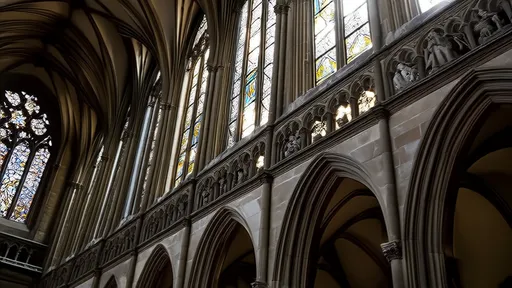
The cultural impact extended far beyond engineering. With walls no longer bearing structural burdens, the Gothic style could embrace light as never before. The famous rose windows of Chartres, the kaleidoscopic narratives of Sainte-Chapelle—these became possible because the flying buttress quietly shouldered the weight elsewhere. Theologians interpreted this as divine metaphor: invisible support making divine light accessible, much like grace in theological terms.
Modern engineers still marvel at the sophistication of these medieval solutions. Laser scans of Notre-Dame de Paris (before the 2019 fire) revealed that many flying buttresses had been subtly adjusted over centuries, their angles perfected to within fractions of degrees. The medieval masons understood something modern software confirms—that these stone wings needed to "fly" at precise trajectories to counteract specific force vectors from the nave vaulting.
Yet for all their importance, flying buttresses remained curiously absent from medieval art and documentation. Illuminated manuscripts depict cathedral construction scenes showing every detail—masons carving, glass being set—but consistently omit the buttresses. Some scholars suggest this reflects contemporary attitudes; the supports were necessary but aesthetically displeasing to medieval eyes, much like modern buildings hide their air conditioning systems.
The Reformation brought new challenges as Protestant critics mocked the architectural theatrics of Catholicism. John Calvin famously derided flying buttresses as "stone crutches for a limping faith." This theological shift coincided with Renaissance tastes favoring classical proportions over Gothic verticality. For two centuries, the technology fell into disuse until the Gothic Revival of the 19th century, when architects like Viollet-le-Duc not only revived the style but openly celebrated the engineering behind it.
Today, conservation teams face unprecedented challenges maintaining these medieval masterpieces. Pollution weakens the limestone, while climate change brings more frequent storms that test the buttresses’ resilience. The restoration of Notre-Dame has sparked debates about whether to reinforce the original design with titanium supports—a modern echo of the medieval innovation itself.
Standing in the shadow of Chartres or Reims Cathedral, one senses the flying buttresses’ paradoxical nature: simultaneously bold and self-effacing, monumental and discreet. They represent perhaps the purest marriage of architectural form and function—elements that dare not call attention to themselves, yet without which the entire edifice of Gothic achievement would come crashing down. In our age of exposed steel and celebrated engineering, these silent stone flyers remind us that the most profound supports often work best when unseen.

By /Aug 18, 2025

By /Aug 18, 2025

By /Aug 18, 2025

By /Aug 18, 2025

By /Aug 18, 2025

By /Aug 18, 2025

By /Aug 18, 2025

By /Aug 18, 2025
By /Aug 18, 2025

By /Aug 18, 2025

By /Aug 18, 2025

By /Aug 18, 2025

By /Aug 18, 2025

By /Aug 18, 2025
By /Aug 18, 2025

By /Aug 18, 2025
By /Aug 18, 2025

By /Aug 18, 2025

By /Aug 18, 2025

By /Aug 18, 2025